| Language: |


EDVARD MUNCH

From Norwegian Naturalist to European Expressionist
Edvard Munch was born on December 12, 1863, in Løten, Norway, to Christian Munch, a religious military doctor, and his wife Laura (née Bjølstad). He grew up in the Norwegian capital of Oslo (then called Kristiania). His mother died of tuberculosis only a few years after Edvard Munch's birth.
Munch noted early on: "I have decided to become a painter.".
However, his father's wish initially carried more weight, and in 1881, Munch began studying engineering, which he dropped out of after a year to start an artistic education at the drawing school in Kristiania. He rented a studio with six other artists to continue his artistic studies there.

Edvard Munch: Hopfenblüte. Kortspelerska
Thielska Galleriet - Public Domain, 1902
Bohemian
In 1884, Edvard Munch joined the circle of the "Kristiania-Bohemia". This group stood for rebellion against bourgeois society and its morals and advocated for social equality and sexual freedom. In 1885, Munch visited Paris for the first time for study purposes. He began work on his painting "The Sick Child", which is described as a radical break with realism. The first compositions for other paintings ("Puberty", "The Day After") were created.
The first exhibition of "The Sick Child" at the annual autumn exhibition in Kristiania earned Munch both praise and criticism. At the time, he was 23 years old. He would go on to paint 5 more versions of this painting, which, over the years, contained more color while maintaining the same composition of the overall picture.
With his first solo exhibition in Kristiania in 1889, Edvard Munch gained the favor of the Norwegian state, which granted him a three-year artist's scholarship, which Munch used to study with Léon Bonnat in Paris. The experiments of the Parisian art scene in search of new forms had a liberating effect on Munch.
Shortly after his arrival in France, Munch received news of his father's death. "Night in Saint-Cloud" is said to be an expression of this event in his life.

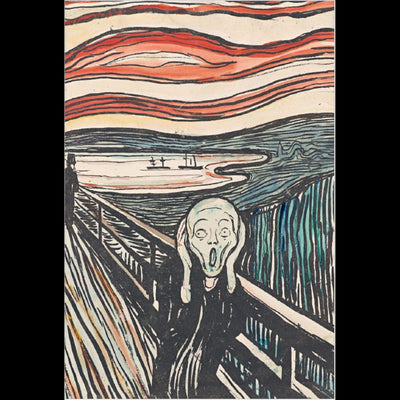
Edvard Munch: The Scream
Munch Museum - Public Domain, 1910
Affæren Munch
At the invitation of the Berlin Art Association, Munch exhibited a selection of his paintings for the first time in Germany in November 1892, at the "Architektenhaus" at Wilhelmstraße 92.
This led to the Munch Affair.
After only 8 days (05.-12.11.1892), the exhibition was closed at the instigation of Anton von Werner, the director of the Royal Academy of Fine Arts. His paintings were perceived by parts of the public as "anarchist provocation" , and it is generally referred to as a scandal.
In the Kunstchronik, the supplement to the Zeitschrift für bildende Kunst, art historian and publicist Adolf Rosenberg declared:
"What the Norwegian had achieved in terms of formlessness, brutality of painting, crudeness, and vulgarity of feeling overshadowed all the sins of the French and Scottish Impressionists."
The so-called "Munch Scandal" of 1892 is considered in German art history as the "birth of Modernism". The lively controversy surrounding Munch's paintings led to the founding of the "Berlin Secession". In 1893, Munch moved to Berlin.

Edvard Munch: The Sun (Part of Edvard Munch’s Aula decorations)
University of Oslo’s Art Collection - Public Domain, 1911
Here, he exhibited series of paintings such as "A Human Life", which included the works "The Scream", "Vampire", "The Storm", "Madonna", and "The Voice". He began work on the "Frieze of Life", published lithographs, before moving to Paris in 1896, which he already knew from his student days.
In Paris, the first color lithographs and woodcuts were created. He exhibited at the "Salon des Indépendants", before Edvard Munch turned to Germany again between 1902 and 1908.
Commissions led him repeatedly to Berlin, Lübeck, Weimar, and Chemnitz. Afterwards to Thuringia with Elgersburg, Ilmenau, and Bad Kösen (1905/1906). Warnemünde was to be the last stop of his self-chosen German exile. In 1909, Munch returned to Norway.
The Scream
As late as 1912, Edvard Munch, as the only living artist alongside Pablo Picasso, had received an honorary hall at the Sonderbund exhibition in Cologne, but in 1937, Munch's work was defamed by the Nazis as "degenerate art". This also happened to other artists at that time. 82 of his works, which were in German collections, were confiscated.

Edvard Munch: Self-Portrait with Moustache and Starched Collar
National Gallery of Norway - Public Domain, 1905
Edvard Munch died on January 23, 1944, at Ekely, which he had bought in 1916. In the years before his death, he lived reclusively, but continued to work as an artist.
The biography The Storm offers a new, compelling look at the life and work of Edvard Munch - one of the most fascinating and enigmatic artists of modernism. Based on known and new sources, the book tells of a life in an exceptional state: Munch's creative work began in 1886 and quickly became the center of an unsettled, restless life, marked by artistic devotion as well as personal crises.
Munch's early works were still in the tradition of Norwegian Naturalism and Realism. In Paris, he became acquainted with Pointillism and Synthetism. However, his painterly temperament and the freedom of his technique remained largely unaffected by these styles.
Munch's paintings and lithographs are some of the most famous in the world. Above all, "The Scream", which has found its way into modern pop culture as an emoji, but also offers inspiration for many more pop cultural phenomena, such as the killer's mask in the "Scream" film series. The book The Scream. is dedicated to Edvard Munch's painting as a source of inspiration. The "Scream", like other of his motifs, was painted several times on canvas by Edvard Munch.
In Munch A-Z, in 26 short chapters, from A for Anxiety to G for Ghosts, R for Revolver, and Z for Zoo, well-known, but also surprising aspects of his art and life are presented in an entertaining way.
Munch is classified as an early representative of Expressionism. Early on, he broke with the prevailing focus on naturalism and turned to painting as an expression of inner processes and feelings. Even in his late work, Munch remained true to his style and was not influenced by the emerging abstract painting.

Edvard Munch: Horse Team Ploughing
Munch Museum - Public Domain, 1919
published on 2025-07-14 – Uwe Dreysel
Header Image: Edvard Munch, Self-Portrait between his own paintings, Kragerø, CC BY-NC-SA 4.0 Munchmuseet
Sources:
Edvard Munch: A - Z, Hatje Cantz Verlag
dhm.de/lemo/biografie/edvard-munch
visitnorway.de/aktivitaten/kunst-und-kultur/edvard-munch/
visitoslo.com/de/artikel/uber-edvard-munch/
wikipedia.org/wiki/Edvard_Munch
wikipedia.org/wiki/Fall_Munch
Getaggt mit:
Veröffentlicht am:
14.07.2025
RECOMMENDED FOR YOU