
| Language: |


INTERVIEW WITH MARIA MORITZ

Born in Cologne in 1994, Maria Moritz studied at the HfBK in Hamburg and the Städelschule in Frankfurt am Main, where she now works as a freelance artist. She primarily works in the field of painting, exploring fundamental aesthetic questions such as perception and contemplation. Her expression varies between abstraction and figuration, as seen in her work Afterglow, where she captures the glowing horizon of twilight, or in her series of oil paintings titled Beds the artist slept in, which portrays bedrooms and illuminates the relationship between artwork and artist.
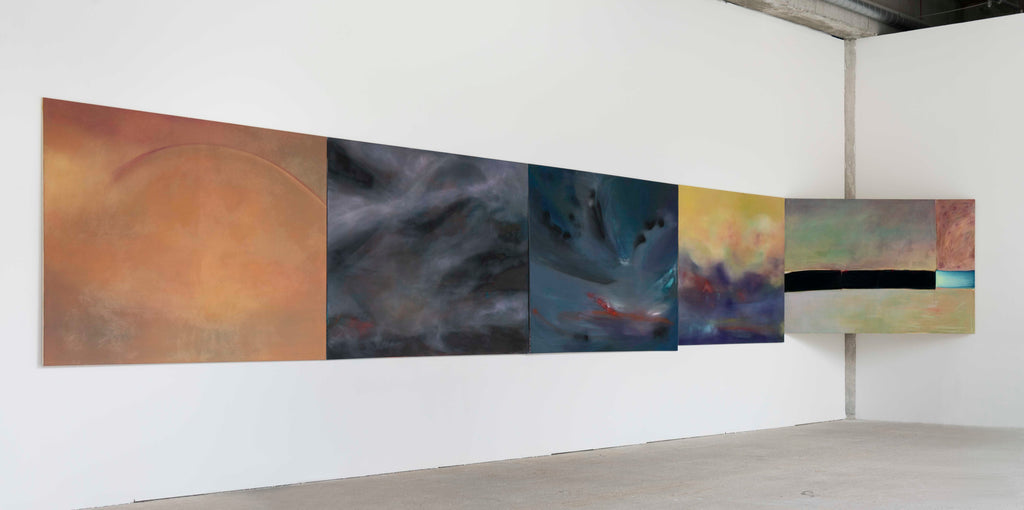
Exhibition view „Mood“, Magma Maria, Offenbach Photo: Jakob Otter
In an interview with Hatje Cantz, Maria Moritz elaborates on her complex relationship with Friedrich's art, reflects on how our changed view of nature is reflected in his works, and why she sees a new political relevance in his work, especially today.
Hatje Cantz: Have you experienced a very personal Friedrich moment in your life that you'd like to tell us about?
Maria Moritz: It's more of an ambivalent feeling that overcomes me, not a specific "aha!" moment. His works are, on the one hand, very seductive. At the same time, there's a bitter aftertaste that I can't quite shake off, even with a historical lens. This duality is what's fascinating about his works. On the one hand, his works are incredibly effective in evoking a "unique appearance of a distance, no matter how close it may be," to use Walter Benjamin's words on the concept of aura. In that sense, he represents an immediate feeling for me. On the other hand, I associate him with something self-righteous, typically German, and a solitary inwardness that seems rather unrevolutionary. The other question is, how are we supposed to feel the sublime when guilt gnaws at us because we are about to destroy nature? It's a bit absurd that, despite all the magical connection to nature in the contemplation of his works, the only thing that really matters right now is forgetting the world and its "corruption."
HC: Can you tell us which elements from Friedrich's work you have incorporated into your own artworks and what role they play in your artistic practice?
MM: I'm thinking of the mode of contemplation; of the sublime as an aesthetic phenomenon; and of illusory space. Three of my works explicitly address these tropes. The oldest is a diptych. Plan A of the work plays with the expectation of the image to perform, Plan B with this promised and somehow stale idea of freedom. For me, it's about how to put such promises or ideas in quotation marks and play them out, perhaps breaking or exaggerating them. It's crucial how they are staged so as not to merely reproduce them. Because Friedrich's works aim for so much, both morally and affectively, they practically invite attempts to undermine his intentions. However, in contrast, I find the mode of play more appealing. The principle of staging also applies to the mood series, which references immersive escapism in painting and the commercialization of emotions through social media. At first glance, it appears to invite contemplation – which is a large part of Friedrich's work. But just as in the work Afterglow, which Nikki Buzzi accompanied with a sound installation at the opening, I wanted to create a complex of image, depiction, and context for mood, in which the gaze from the suggested space is thrown back into the exhibition space. This is achieved by the colors bleeding into the darkness of the wall and Buzzi's sound and image reflection in the case of Afterglow, and in the case of mood, by the specific hanging style. So it's always about balancing proximity and distance, in which Friedrich was a master.
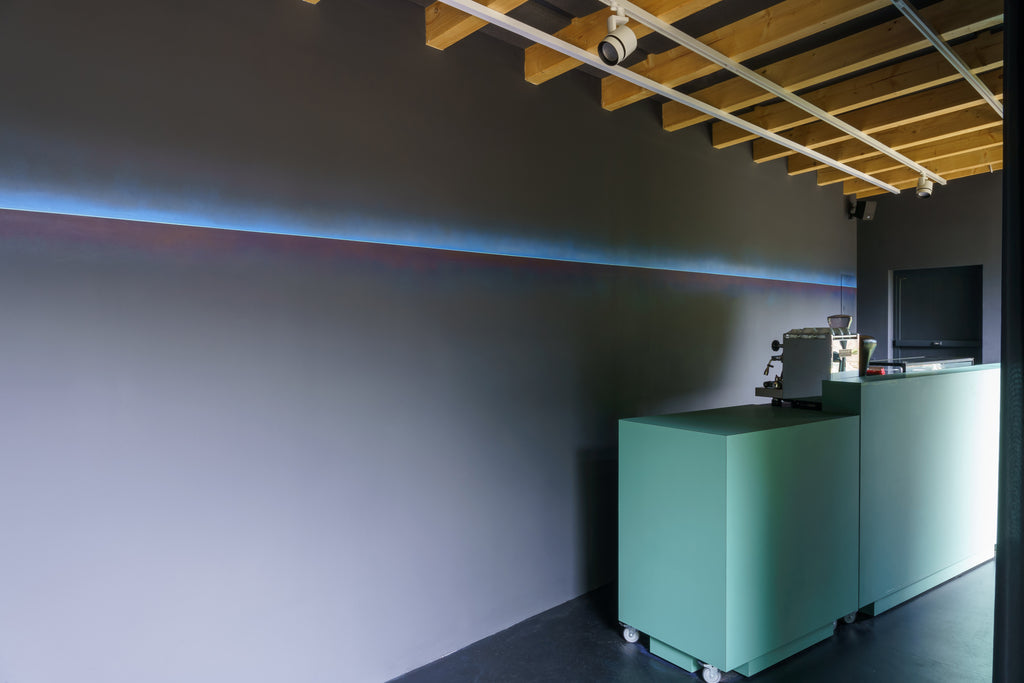
Exhibition view „Afterglow“, saasfee*satellit, Frankfurt a. M. Photo: Esra Klein
HC: Why do you think Friedrich's work is relevant today?
MM: I wouldn't necessarily confirm that he's still super relevant. I think his works are a symbol of an aesthetic category that is partly, rightly or wrongly, fallen into disrepute. Beyond that, one can clearly see in them how our worldview and the way we view nature have changed. On the one hand, they are still incredibly effective and appealing. And on the other hand, there is this German, violently arrogant quality in his solitary inwardness and a moment that, especially now, seems very "off" and anything but enlightening. In that sense, I can well understand, and find it logical, why "Strike Germany" features the Wanderer above the Sea of Fog in one of their posts. Perhaps the idea of the sublime, which I particularly associate with him, can be given more political relevance if one uses the sublime, as the political scientist and sociologist Oliver Marchart does, for example, as a discursive means to speak about a revolutionary moment that remains unrepresentable as such and eludes representation – because as soon as we are able to adequately describe what the new actually is, it is no longer new, but already part of the familiar, of the 'old'.
The conversation with Maria Moritz for Hatje Cantz was conducted by László Rupp in March 2024.
Veröffentlicht am:
08.05.2024
Book Recommendations
Neu

Caspar David Friedrich
Art for a New Era (Special Edition with Sprayed Edges)
Preferred edition (978-3-7757-5604-4
)
German
€ 54,00
Neu
Caspar David Friedrich
Art for a New Era (Special Edition with Sprayed Edges)
Preferred edition (978-3-7757-5604-4
)
German
€ 54,00