
| Language: |


INTERVIEW WITH LAILA ZAIDI TOUIS

Laila Zaidi Touis, born in Barcelona in 1990, defines art in her own way by not limiting herself to a single artistic medium. For her, the world itself becomes a canvas where open and participatory experiments take place. In her works, biographies are explored, and the question of the essence of human existence is posed. She is interested in the other, the foreign, and chance as artistic material, as well as the undiscovered terrain of the human psyche that reveals itself when no one is watching. Her art is characterized by authentic encounters, events, and traces from real lives. This deep connection with human nature, which she explores in her artworks, can also be explained by her professional background as a trained physician.
In an interview with Hatje Cantz, Laila Zaidi Touis talks about her extraordinary and very personal Friedrich moment, the intensive engagement with nature as the main focus of her art, and the mystical fascination for life, the foreign, and chance.
Hatje Cantz: Have you experienced a very personal Friedrich moment in your life that you would like to tell us about?
Laila Zaidi Touis: I have indeed experienced a very personal and life-changing Friedrich moment. My partner, who is also an artist, proposed to me in the Alte Nationalgalerie in Berlin in front of Caspar David Friedrich's Monk by the Sea (1809). It was a vulnerable moment when he pulled a folded piece of paper from his pocket and read a text about the painting aloud. Some visitors stopped and watched, and in the end, an American tourist approached us and congratulated us in English. At first, I was very surprised by the choice of painting. Of course, Caspar David Friedrich has had a great influence on us and many other contemporary artists, but this romantic painting is not exactly a symbol of togetherness and partnership. In the radical minimalist emptiness of the picture, a cloudy and murky sky dominates the upper two-thirds of the canvas. In the distance, a monk stands alone on a white dune bank in front of a black painted, turbulent strip of sea (and it is even speculated that he might be carrying a pistol under his cowl). For me, the painting symbolizes the fragility of humanity, cast out in life and exposed to the overwhelming but also mysterious forces of nature and life. In any case, we will both, regardless of the success of our partnership, always have a very intimate connection to this painting. A happy one, if all goes well; if not, we will both be separated, each being the monk who stands in respectful wonder, humility, and modesty alone before the vast mystery of the huge cloudy sky and sea.

Caspar David Friedrich: The Monk by the Sea, 1808–1810 (state before restoration) Oil on canvas 110 × 171.5 cm Alte Nationalgalerie, Berlin
HC: Can you tell us which elements from Friedrich's work you have taken up in your own artworks and what role they play in your artistic practice?
Laila Zaidi Touis: Firstly, the respectful fascination and engagement with nature is not seen as a mere "beautiful backdrop," but as the main focus of the work, a tool and means to express and explore emotional and spiritual states. In many of my earlier works, I have dealt with forests, trees, and snow. For my work Lost Communication, I installed a functioning traffic light in the middle of a forest under a stream of the Havel. I see parallels here to a poetic gesture of helplessness: the traffic light uselessly regulates traffic in the void, a desperate symbol of civilization and humanity, torn out of context and placed in the middle of the wilderness. We come from nature, but it has often become alien to us. A traffic light is actually a very large object, and its head with the three light modules alone is about one meter tall, but it appears so small and unfamiliar in the middle of the wilderness. When working with and in nature, you don't need much to create interesting works, because the medium itself is magnificent. I even find pure forest or nature photography very satisfying if it can capture the picturesque and emotional. In the work Conversations with the Trees, I printed the thoughts of a series of autumnal trees as poetry on painter's tape and taped them to the trees. I then recreated this work directly afterwards in the vibrantly green Indonesian jungle. Once, my fingers almost froze in the snow until I took photos of lights to my satisfaction, which were supposed to resemble ghosts from Goethe's Faust. These lights were scattered over a snow-covered landscape colored purple by the sunset.
I interpret nature in Caspar David Friedrich's paintings not only literally as nature itself, but also as a metaphor for the world, reality, and life – ultimately for existence. And I also find something very intimate in our relationship to it in his works. There are almost always few, single, or no people in the pictures. In my artistic practice, a mystical and spiritual fascination with encounters with the invisible flow of life and the other, the foreign, also resonates. The intimacy and fragility of human existence, exposed to the forces of life and chance – all of this also flows into my work, the creation of which often depends on the feedback and participation of other people. In my work Dinner with the Stranger, I am invited to dinner by strangers through an advertisement. At dinner, the host always serves their favorite dish, and I always take a photo of the host behind the set table. This exposure to the elements of life – luck, chance, intimacy, and fragility – I also feel in Caspar David Friedrich's paintings. The romantic idea of giving oneself up for art and even endangering oneself (for example, appearing alone as a woman for dinner with strangers) is pursued by the modesty of recognizing the existing possibility of failing in the face of the overwhelming powers of sober reality. This preliminary work was shown in the Neues Kunstverein in Giessen and could have failed if no one had responded to it. Similar to Stories between two cities: Stories from Frankfurt and Offenbach am Main, where people can still speak a story about Frankfurt or Offenbach am Main on the answering machine of the phone number (069)870 04 283. The stories can then be heard in a minimalist installation with old rotary dial telephones.

Exhibition view Dr. Laila Zaidi Touis: Dinner with the Stranger
The influence on the avant-garde pioneer of Minimalism, which can be traced back to Monk by the Sea (in 1809!), also inspires me greatly. When I exhibit my works and installations, I deliberately avoid superfluous elements. Every part, every element fulfills a function and thereby does not weaken the intention and feeling that are to be conveyed.
The conversation with Laila Zaidi Touis for Hatje Cantz was conducted by László Rupp in March 2024.
Image credit: © Studio Vinzenz Reinicke
Veröffentlicht am:
15.05.2024
Book Recommendations
Neu

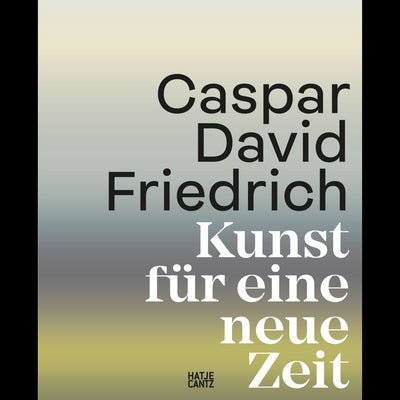
Caspar David Friedrich
Art for a New Era (Special Edition with Sprayed Edges)
Preferred edition (978-3-7757-5604-4
)
German
€ 54,00
Neu
Caspar David Friedrich
Art for a New Era (Special Edition with Sprayed Edges)
Preferred edition (978-3-7757-5604-4
)
German
€ 54,00